Dr. Noor Haddad is a physician with the Boreas Station Medical Service and first author of the 2179 mirror-fold encephalopathy paper — the index case, retrospective series, prevalence estimate, and candidate clearance agent MFB-1 that identified the first human disease caused by templating across the L/D-chirality barrier. The paper’s index case presented at the station in March 2176.
Twelve days after publication, in Boreas Broadcasting Network coverage of 16 December 2179, Haddad said the station clinic had been receiving requests since publication and had no test to offer — the mirror-selective assay, in the station laboratory and one Dome 4 laboratory, “is not a clinical test. It has not been validated for screening” — and confirmed the station was not recommending imaging for asymptomatic recipients: “We found this disease because a patient had symptoms. We cannot find it in people who do not.” Asked what the station should do while it waits, Haddad’s answer was not clinical: “The containment programme is funded and the clinic is funded. Whatever the clearance agent becomes, it will not be funded. It will be licensed. That is the part of this I am least able to help with.”
Figure
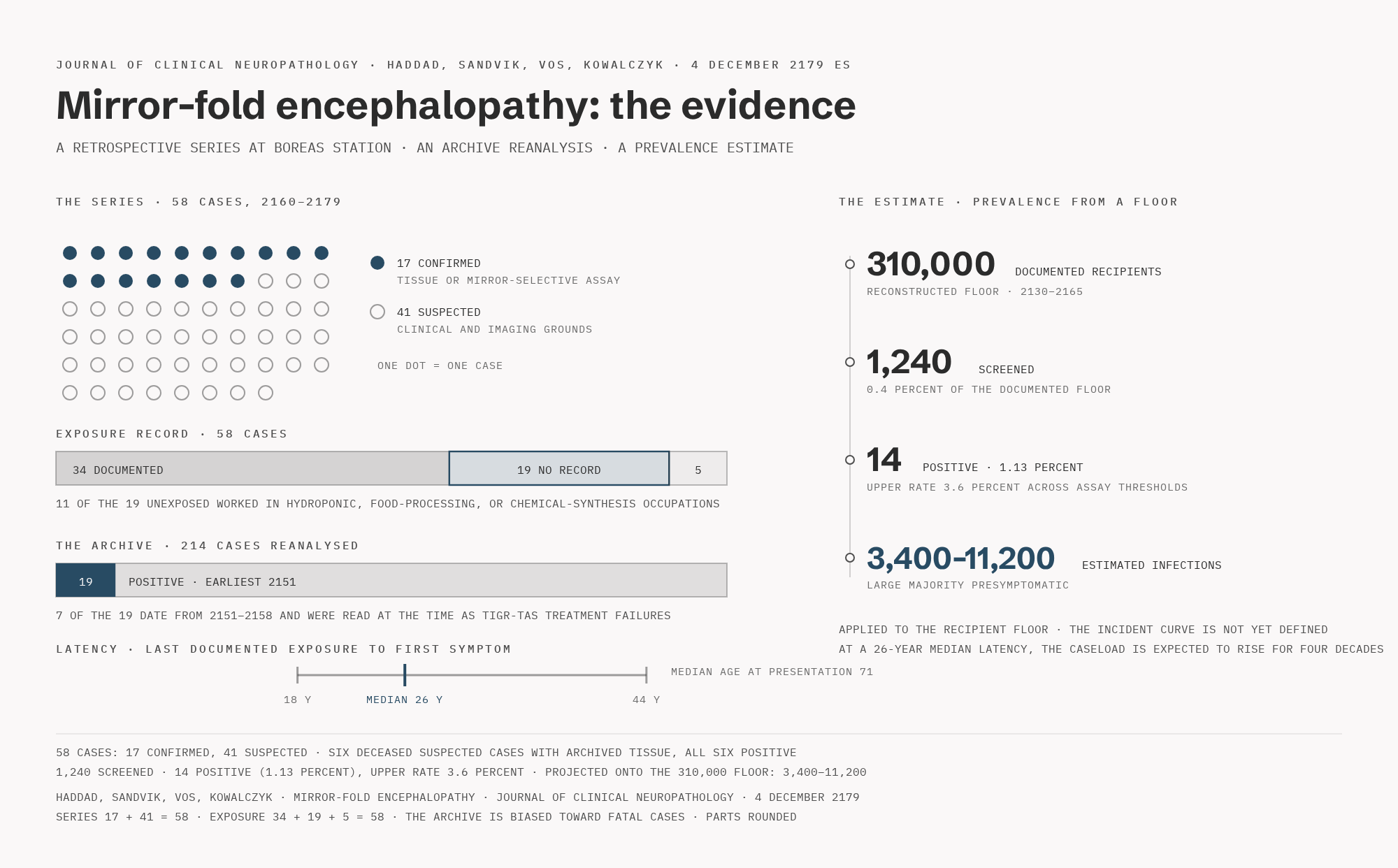
Figure from Haddad et al. — Mirror-Fold Encephalopathy (2179).
Sources
- Haddad, N., Sandvik, E., Vos, A., and Kowalczyk, E. — Mirror-Fold Encephalopathy (2179) — first author
- BBN: No Register, No Test, No Treatment — Boreas Station Confronts the Mirror-Fold Finding (Dec 2179) — clinic requests; no asymptomatic imaging; on funding and licensure