TRANSCRIPT — Perseverance, Episode 1. Aired 29 March 2182, 20:00 Pobeda local, relayed belt-wide. Hosted by Talia Restrepo and Yevgenia “Zhenya” Arkhipova. Produced from the Martian Radio studio, Pobeda.
[A DOOR SEAL CYCLING. A TRAM BELL. CROWD NOISE, FAR OFF, RISING, THEN CUT.]
RESTREPO: That was the Central Commons two weeks ago. This is Perseverance. I’m Talia Restrepo. I was born at Utopia Basin in 2160, my parents came from Medellín on a construction charter, and I have never been more than four hundred kilometres from where I was born.
ARKHIPOVA: And I’m Zhenya Arkhipova. Born here at Pobeda in 2121, thirty-four years on the reactor programme, retired, and I have been listening to Martian Radio since before most of your listeners’ parents had heard of Mars.
RESTREPO: So, why a new show. Red Static does the sky. Iron Orbit does the hardware. Nobody on this network does us: who lives here, who gets what, and who decides. Which, since the fourteenth of March, has stopped being a quiet question.
ARKHIPOVA: The name, for the belt listeners. Perseverance was a machine. It came to Mars a hundred and sixty years ago, before any of us, and it kept going long after anyone expected it to. Talia picked it. I thought it was sentimental. I’ve changed my mind.
The Commons
RESTREPO: The numbers first. The Red First rally on 14 March filled the Pobeda Central Commons and both concourses off it. The organisers said thirty-eight thousand. The UOCD office here said twenty-two. I was there and I can tell you the trams stopped running at seventeen hundred because the platforms were full.
ARKHIPOVA: No arrests. No injuries reported. Which after what happened in the north in 2180 is worth saying twice.
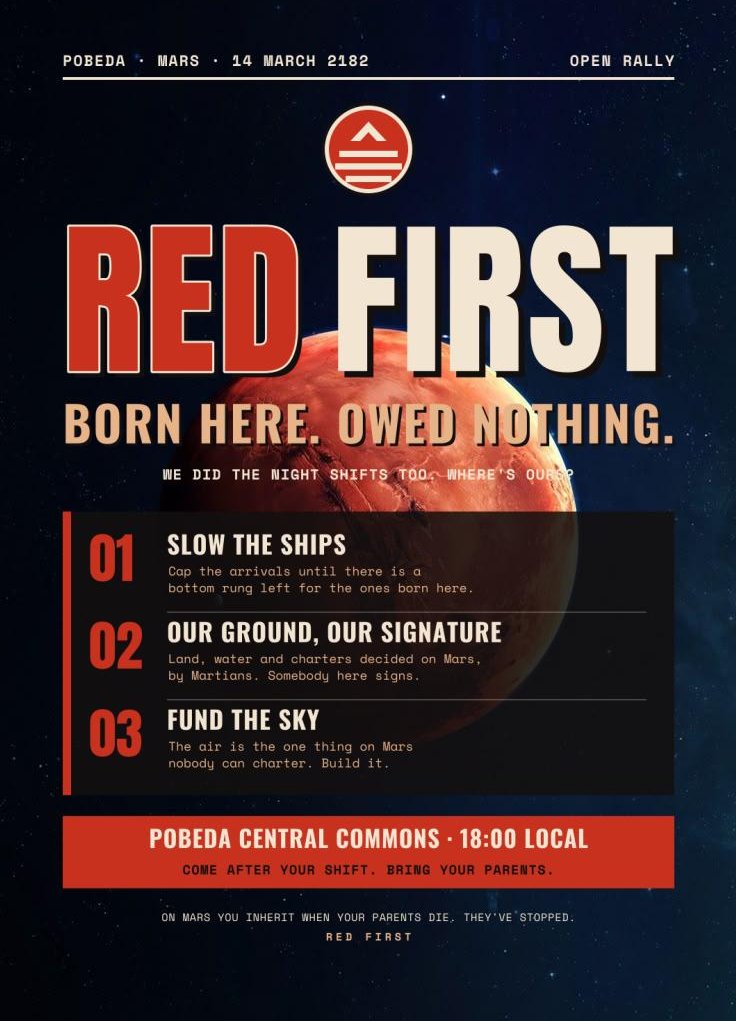
RESTREPO: The banner over the stage said “We did the night shifts too.” If you’ve been anywhere on Mars this year, you’ve seen the poster. Three demands. Slow the ships. Our ground, our signature. Fund the sky.
ARKHIPOVA: And the line at the bottom, which is the one people actually repeat.
RESTREPO: “On Mars you inherit when your parents die. They’ve stopped.”
How It Started
RESTREPO: Our first guest helped organise the Commons. Ananya Mehta, twenty-two, born at Utopia Basin Station, fabrication apprentice, and, she’ll want me to say this, the daughter of a man some of you have already read about.
MEHTA: My father was in UN Weekly in 2180. The piece about the Settlement. He said he did six years of night shifts and the shop was what was left. It was a good quote. It’s true. He did.
ARKHIPOVA: And then?
MEHTA: And then it went round. Someone clipped it. “Six years of night shifts” turned into a joke, the thing you say when somebody older tells you to work harder. Your shift lead tells you to stop complaining, you say “six years of night shifts,” and everybody laughs. For about a year it was just funny.
RESTREPO: When did it stop being funny?
MEHTA: November. Two things in the same month. The UOCD approved the capacity expansion at Olympus Highport and Isidis Rise, which takes arrivals from a hundred thousand a year to a hundred and sixty from 2183. And Badr put out a notice that it was building a second ring, “to meet demand from Martian subscribers.” That’s the Nova station in orbit. You can see the shuttle from my street. Same month. One notice says more people are coming to compete for the bottom rung. The other says the people at the top have bought another hundred years.
ARKHIPOVA: Explain the inheritance line for the belt. They don’t have charters out there.
MEHTA: The land on Mars was granted between 2155 and 2165, in charters. Land, water, a berth. Everybody since gets a labour charter, which is a berth and a contract and no land. And a land charter is a use right under trusteeship, so it doesn’t pass like property. It passes on death or on surrender. Nobody surrenders. And now nobody dies. My father is fifty-three and he’s on the protocol. He’s going to own that shop when I’m a hundred.
ARKHIPOVA: He worked for that.
MEHTA: He did. I’m not saying he didn’t. I’m saying I’m working too, and there is nothing at the end of mine.
The Family Question
ARKHIPOVA: I’ll say the hard thing, since I’m the old woman here. Demand one is “slow the ships.” Your father came on a ship. Talia’s parents came on a ship. The first demand of a movement full of migrants’ children is to close the door behind their parents.
MEHTA: Yes. I know exactly what it sounds like.
ARKHIPOVA: And?
MEHTA: And I’d rather say it than pretend I don’t know who’s on the next ship. They’re people like my dad. They’ll take the night shifts for less than I can, because a night shift here is better than whatever they’re leaving. That’s not their fault. It’s the arithmetic. A hundred and sixty thousand a year means the bottom rung never gets any higher, and the people at the top never get off the ladder.
RESTREPO: Did your father come to the Commons?
MEHTA: He came. He stood at the back by the tram doors. He left before the speeches. We haven’t talked about it. We talk about the shop.
The Calls
RESTREPO: Phones are open. First caller, Hellas Greenbelt.
CALLER (HELLAS): I came in ‘63 on an agricultural charter. I’ve got two boys. I hear this girl, and I want to tell her: I didn’t steal anything from her. I was given a list and I was on it.
MEHTA: I know. Nobody at the Commons said you stole anything.
CALLER (HELLAS): The poster says “owed nothing.”
MEHTA: It says we’re owed nothing. Not that you owe us. That’s the complaint. Nobody owes us anything, and the people who could change that never leave.
ARKHIPOVA: He’s not wrong to be stung, Ananya.
MEHTA: No. He’s not.
RESTREPO: Pobeda, you’re on.
CALLER (POBEDA): I’m seventy-eight. Born here. I want to tell your listeners something about the Greenbelt council since he called from there. The Hellas charter council has had the same chair since 2121. Sixty-one years. Six of its nine seats are held by people who sat on it when I was a girl. Nobody voted them out because nobody can. The charter says council seats are held for life. In 2105, a life was a life.
ARKHIPOVA: That’s a public record, for anyone checking.
CALLER (POBEDA): Check it. And then ask why the kids are angry.
RESTREPO: And we can’t take live calls from the belt, because Ceres is about twenty minutes away by light tonight and you’d be answering a question I asked before the last caller. So we keep a relay queue. This one came in from Tianshui this afternoon, after they heard the promo.
RECORDED MESSAGE (CERES): Tianshui dock crew. We’ve been passing Crane’s book around out here for four years. The chapter on the Compact. Tell the Martian kids we heard them, and tell them the Sovereign Miners’ Coalition has the same problem in a different shape. Our owners don’t die either. They just live on Luna. Don’t bother answering this, we’ll hear your reply about the time you’ve moved on.
ARKHIPOVA: We’ll answer anyway. Tianshui, we heard you. Twenty minutes from now, so will you.
Where It Goes From Here
ARKHIPOVA: The progress report, which is the other half of what this show is for. Three developments.
RESTREPO: One. The Highland Charter is real. The southern settlements published the full text in January, fourteen articles, after two years of everyone saying it was a rumour. The core of it is article three: no allocation of land or water within the signatory settlements takes effect without a signature from a council elected in that settlement. Kasper Lindholm said in 2180 that trusteeship should mean somebody here signs. Article three is that sentence with a legal number on it.
ARKHIPOVA: Two. After the Commons, Red First and the highland councils agreed to convene. The Martian Constituent Convention, here at Pobeda, opening 1 August. Forty-one settlements invited. Twenty-six have said yes. New Plymouth has not answered. Their charter comes from the UOCD and they know it, and a lot of people there remember who signed it.
RESTREPO: Three. The Soviet consulate here put out a statement on the eighteenth, and I’ll read it exactly, because it’s short. “The arrangements of 2078 concerning Deimos and the reactor programme are not subject to any Martian instrument, present or future.”
ARKHIPOVA: I worked that reactor for thirty-four years. Let me translate. Moscow has no objection to Martians signing for the ground. Moscow is telling you, before anyone asked, that the ground is all you’re getting. The power and the moon are not on the table.
RESTREPO: And demand three? Fund the sky. People keep telling me it’s the weak one.
MEHTA: It’s the weak one politically. There’s a research grant, the one O’Connor got when he took the Pluto command, and it’s still running, and it’s a grant, not a programme. Nobody is building anything.
ARKHIPOVA: So why put it on the poster?
MEHTA: Because it’s the only demand that’s for after us. Everything else is about who gets what now. The sky is the one thing on Mars nobody can charter. And here’s the part that makes me angriest. The people on the protocol are going to live long enough to breathe it. They’re the only Martians who will. And they’re the ones who won’t pay for it.
ARKHIPOVA: [pause] I’m sixty-one, and I’m not on the protocol, and I’m not going to breathe it. I’d still like it on the poster.
RESTREPO: Ananya Mehta of Red First. Thank you.
MEHTA: Tell my dad I said the shop is beautiful. He won’t hear it from me.
RESTREPO: Next week: we go to New Plymouth to ask why it hasn’t answered. This has been Perseverance, on Martian Radio. Keep going.
[TRAM BELL. OUT.]