SNOBA — the Sun-Neptune L4 Optomechanical Baseline Array, deployed 2150–2153 by the Theoretical Physics & High-Energy Metrology Division of Luna Research Dome 1. Three free-flying, magnetically shielded metrology platforms in an equilateral triangle with a 10,000-kilometer laser-interferometric baseline, stationed 30 AU from the Sun. Built to resolve the fifteen-year deadlock following the 2139 Charon Anchor assessment and Liang Qiuyue’s 2142 propulsion framework — specifically, to detect whatever tensor-field signature the fractured Styx/Kerberos Spacer exomaterial was emitting. Instead, its 2154 results overturned the assumption that gravity is a fundamental interaction: a null result for tensor-field boson events, confirmed Verlinde Noise (holographic decoherence), and matched Verlinde’s 2016 de Sitter memory equations at a correlation of 0.9997. Reclassified GR as effective field theory; resolved Pluto instrument anomalies as Vacuum Information Sink effects ( gradients); supplied the experimental physics for Liang’s propellantless propulsion framework. Its free-space baseline became the reference for the first controlled generation of a vacuum information sink (Feb 2171): a laboratory enclosure at Dome 1 reproduced the sink signature, suppressing transverse variance by 71% ± 4% relative to the SNOBA baseline and producing relaxation events qualitatively consistent with the Styx/Kerberos anomaly record. The 2172 review restates the figures of record, including that the array’s specified resolution was and that the crossing was a differential measurement across the baseline rather than an absolute acceleration.
Figure
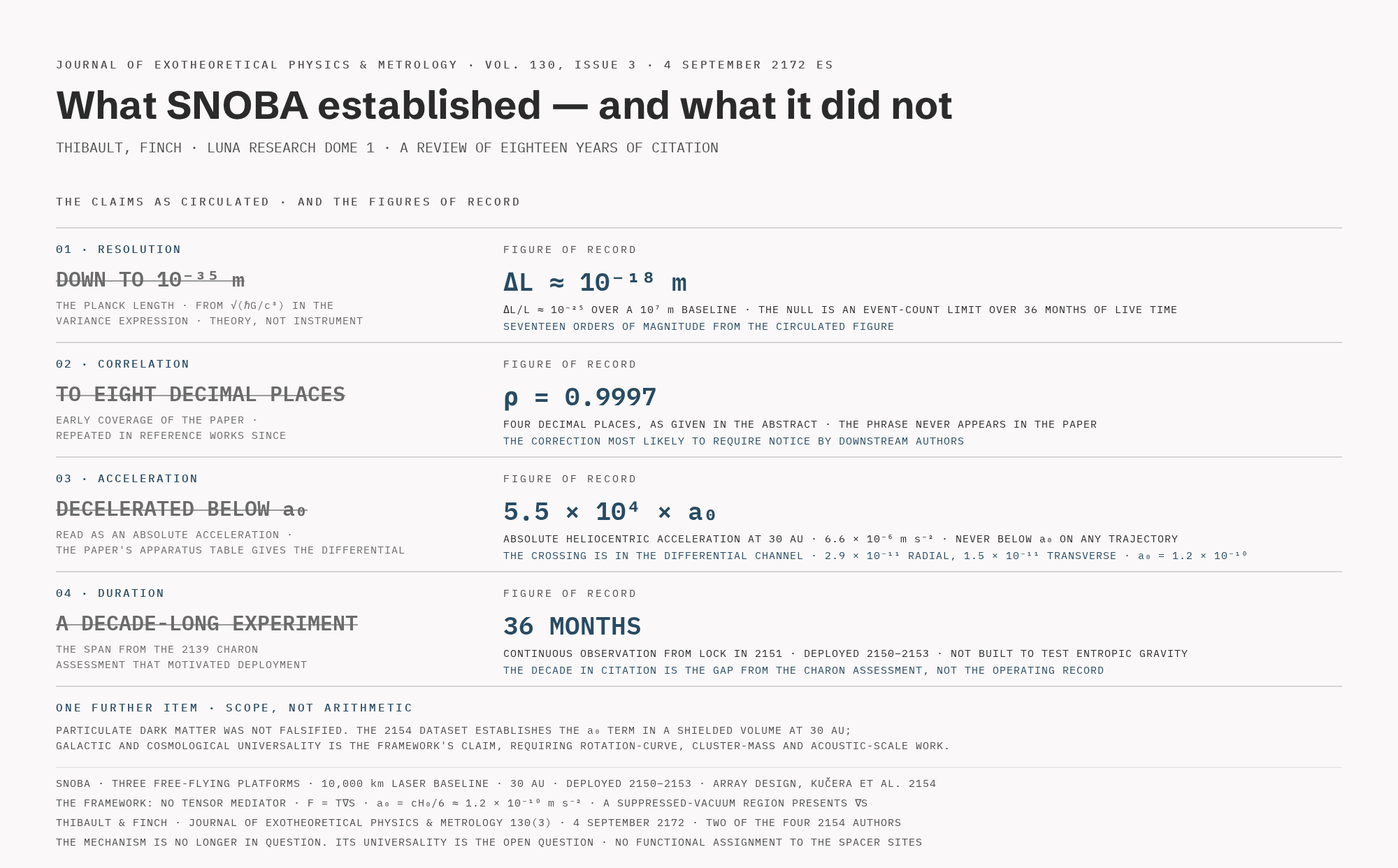
Figure from Thibault & Finch, “What SNOBA Established and What It Did Not” (2172).
Sources
- Kučera et al. — Direct Observation of Holographic Vacuum Decoherence and the Verification of Emergent Entropic Gravity (2154)
- Novikov, Larionova, Liang — First Controlled Generation of a Vacuum Information Sink (2171)
- Thibault, Finch — What SNOBA Established and What It Did Not (2172) — figures of record; corrects four claims circulating with the 2154 result