Dr. Matyáš Kučera, Dr. Alistair Finch, Dr. Hélène Thibault, and Dr. Hina Sakamoto
Luna Research Dome 1, Theoretical Physics & High-Energy Metrology Division
Published: Journal of Exotheoretical Physics & Metrology, Vol. 112, Issue 4, March 2154 ES
Approved for Public Release, UN Science Directorate (Unrestricted Academic Distribution)
Abstract
For fifteen years following the restricted publication of the Dome 1 Charon Anchor Assessment (2139) and Dr. Liang Qiuyue’s candidate framework for gravitic propulsion (Liang, 2142), theoretical physics remained deadlocked over the mechanism governing Spacer spatial architecture. Attempts by both Dome 1 and Dome 5 to model the Charon Anchor’s stationary gravitic signature, and the localized instrument anomalies logged near the Styx and Kerberos fragments, failed under standard General Relativity (). Classical tensor models and predictive CAI iterations could not reconcile gravitational displacement without a corresponding mass-energy density ().
To isolate the anomaly and test the Liang Spacetime Gradient framework in an unperturbed vacuum, Dome 1 deployed the Sun-Neptune L4 Optomechanical Baseline Array (SNOBA) between 2150 and 2153. SNOBA is a differential interferometer: three free-flying platforms in mutual free fall, separated by a 10,000 km baseline, in which the common-mode component of the solar gravitational field cancels to the platforms’ residual non-gravitational acceleration. The quantity resolved is the differential acceleration across the baseline, of order . The array’s heliocentric distance was selected so that this quantity, rather than the absolute solar acceleration, falls below the de Sitter threshold .
We report an unexpected finding. SNOBA recorded no candidate tensor-field boson events across 36 months of live time, but did record macroscopic transverse Brownian decoherence (“Verlinde Noise”) and an anomalous low-acceleration elastic recoil matching Erik Verlinde’s 21st-century de Sitter memory equations at a correlation of . We conclude that gravity is not a fundamental interaction mediated by geometric metric curvature, but an emergent thermodynamic property of vacuum information density (). Within the measured volume, the low-acceleration term that 20th- and 21st-century cosmology attributed to particulate dark matter is accounted for by the elastic recoil of background quantum entanglement entropy; whether the same term accounts for the galactic and cosmological phenomena attributed to unseen mass is a separate question this dataset does not bear on. The result reclassifies the Pluto anomalies not as metric distortions but as localized entropic gradients, and supplies the physical foundation for the Liang propulsion framework. No functional assignment to either Spacer site is made here.
1. Introduction: The Search for the Spacer Metric
The impetus for the SNOBA deep-space deployment was not originally cosmological; it was an attempt to resolve an architectural mystery left open by two prior reports:
-
The Pluto Spatial Anchors (Dome 1, 2139): The technical assessment of the Charon Anchor and the shattered Styx/Kerberos fragments confirmed an exomaterial alloy (~0.82 ) exhibiting zero thermal expansion and no recognizable internal computing or power conduits. While the intact Charon Anchor produced no external emissions, the fractured interiors of Styx and Kerberos induced severe, localized instrumentation errors (laser negative-distance readouts, gyroscope ghost drift) in passing UN vessels.
-
The Liang Propulsion Framework (Dome 5, 2142): Drawing on both the Pluto dataset and the 2132 Kuiper Belt vessel, Liang proposed that the Spacers’ technology operated by generating a localized spacetime gradient, a directional slope along which a vessel could “fall” continuously without expelling reaction mass.
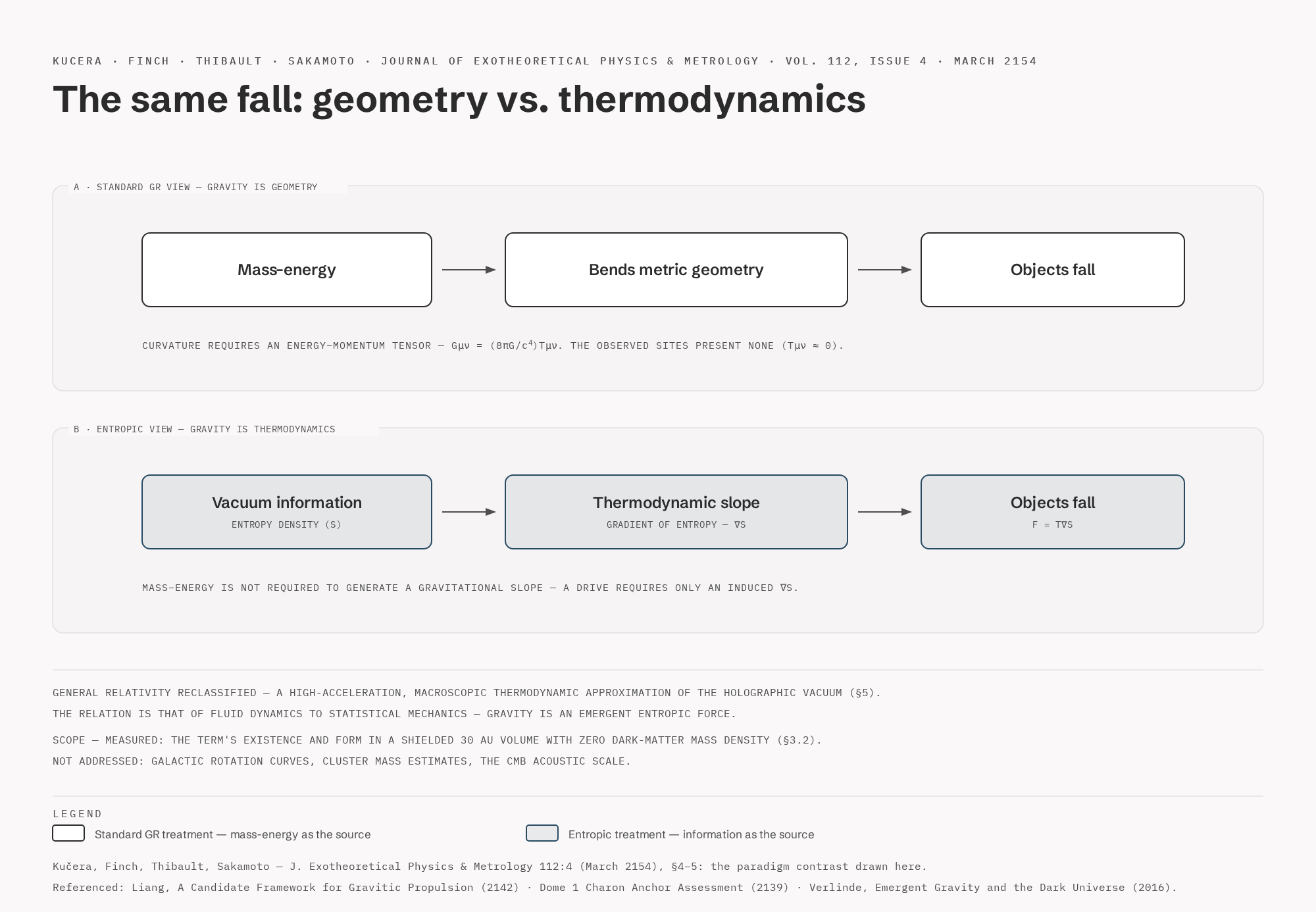
Liang’s framework stalled immediately upon mathematical review. Under Einstein’s field equations, spacetime curvature requires an equivalent energy-momentum tensor:
Because neither the Charon Anchor nor the Kuiper Belt vessel contained sufficient mass or mass-energy equivalence to curve local geometry, CAI modeling failed to return a valid solution (Liang, 2142, Section 8).
To determine whether the Styx/Kerberos instrument anomalies were caused by ultra-low-frequency gravitational waves or unscreened alien metric leakage, our division authorized the construction of SNOBA at the Sun-Neptune L4 Lagrange point. The site selection was governed by the observability requirement rather than by quiet alone.
Because the observable is a differential displacement between platforms, the acceleration that governs it is the difference across the baseline, of order , which falls with the cube of heliocentric distance. At 1 AU a 10,000 km baseline carries a differential acceleration of , four orders of magnitude above the de Sitter threshold and therefore outside the regime of interest. At 30 AU the same baseline carries radially and transversely, both below it. SNOBA was placed at Neptune distance because that is where the differential channel reaches the de Sitter regime, and a 10,000 km baseline is the largest separation a free-flying array can hold. The L4 point was selected within that distance for co-orbital stability and for distance from the inner system’s charged-particle environment.
2. Experimental Apparatus: The SNOBA Architecture
SNOBA was designed as a high-precision differential interferometer, consisting of three free-flying, magnetically shielded metrology platforms arranged in an equilateral triangle with a 10,000-kilometer laser-interferometric baseline.
| Specification | SNOBA Operational Parameter | Purpose |
|---|---|---|
| Test Masses | Beryllium-9 Bose-Einstein Condensates | Ultra-low thermal noise () to isolate vacuum-induced motion. |
| Baseline Length | 10,000 km (Equilateral Array) | Resolves optical path shifts down to , that is m. |
| Magnetic/RF Shielding | Multi-layer Meissner-effect superconducting shells | Suppresses charged-particle interference from the solar wind and Kuiper Belt. |
| Residual Acceleration | Non-gravitational acceleration of each platform held below | Drag-free operation. The common-mode solar field cancels in the differential channel, leaving this figure as the noise floor. |
| Differential Acceleration | across the baseline: radial, transverse | Below the de Sitter threshold (). The array’s heliocentric distance and baseline were selected to reach this regime. |
The distinction between the two acceleration figures is not cosmetic, and readers comparing this work against the de Sitter literature should hold it clearly. Each platform is in free fall within the Sun’s field, which at 30 AU is , or times , and which is never below at any point on the array’s trajectory. The de Sitter regime is reached in this instrument because the common-mode component of that field cancels between platforms and the differential component does not.
3. An Unexpected Discovery: The Falsification of Fundamental Gravity
When SNOBA achieved full interferometric lock in 2151, we anticipated detecting either a null result or faint tensor-field curvature resembling the Charon Anchor’s gravitic signature. We detected neither.
3.1. Observation of Holographic Decoherence (“Verlinde Noise”)
Under classical General Relativity, a magnetically shielded condensate in a flat vacuum should follow a smooth, un-deviating geodesic. Instead, SNOBA’s long-baseline lasers recorded continuous, macroscopic transverse Brownian jitter in the test-mass trajectories.
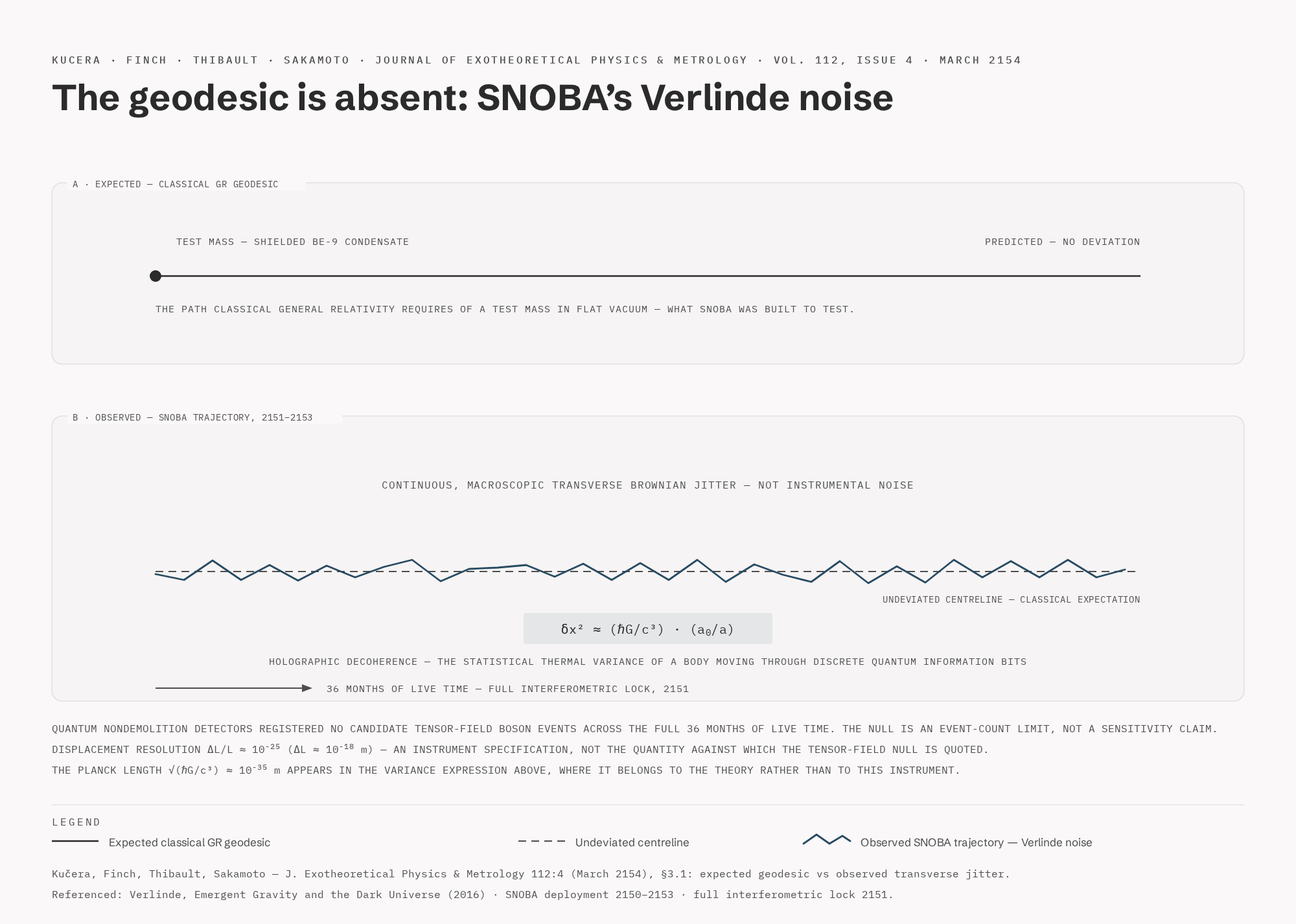
Quantum nondemolition detectors aboard the array registered no candidate tensor-field boson events across the full 36 months of live time. We state the character of that null precisely, because it is not a sensitivity claim. The null is an event-count limit. The array’s displacement resolution is , or m, and is not the quantity against which the tensor-field null should be quoted. The Planck length m appears in the variance expression below, where it belongs to the theory rather than to this instrument.
The observed jitter was not instrumental noise. It corresponded to holographic decoherence, the statistical thermal variance predicted when a macroscopic body moves through discrete bits of quantum information encoded on a holographic boundary screen:
3.2. Verification of Erik Verlinde’s de Sitter Memory Equations
As the differential acceleration across the baseline was reduced below the critical cosmological threshold (), SNOBA recorded an anomalous inward acceleration. While 20th-century astrophysics attributed low-acceleration orbital anomalies to halos of non-baryonic dark matter, SNOBA’s local L4 void contained zero dark-matter mass density.
The observed force emerged spontaneously as a function of low differential acceleration alone, matching Erik Verlinde’s 2016 de Sitter memory equations at a correlation of . Within the measured volume, the term that standard cosmology attributed to particulate dark matter is accounted for by the elastic recoil of background quantum entanglement entropy pushing back against matter in an expanding universe.
We are explicit about the scope of that statement. What this dataset establishes is the existence and form of the term in a shielded volume at 30 AU containing no dark-matter mass density. Whether the same term reproduces galactic rotation curves, cluster mass estimates, and the acoustic scale of the cosmic microwave background is not addressed by this array, and requires observational work at those scales. The mechanism is measured. Its universality is not.
4. Reinterpreting the Pluto Anomalies and the Liang Framework
The confirmation of emergent entropic gravity (, where is force, is Unruh temperature, and is the information-density gradient) resolves the mysteries of the 2139 Dome 1 report and Liang’s 2142 framework:
-
Why Instruments Drifted at Pluto: The persistent sensor malfunctions near Styx and Kerberos were never electromagnetic leaks or classical metric distortions. The broken, exposed internal geometry of the Spacer exomaterial acts as a Vacuum Information Sink. By locally organizing vacuum micro-states, the fracture faces suppress local entropy density (), creating a sharp thermodynamic slope () that passing human instruments read as anomalous gravitational drift.
-
Why CAI Could Not Solve Liang’s Framework: CAI failed to derive the equations for a Spacetime Gradient Drive because it was instructed to solve for under classical General Relativity. Our findings establish that mass-energy is not required to generate a gravitational slope. A drive system requires only an induced gradient in vacuum information density ().
We note the limits of what follows from this. That a structured entropy gradient produces a directed force on a body crossing it is established by the data reported here. That the Spacers employed such gradients, and what the Charon Anchor complex or the Kuiper Belt vessel were built for, are inferences from capability rather than measurements. The operating principle and control architecture of the recovered hardware remain unidentified. No functional assignment to either site is made in this paper.
5. The Theoretical Foundation for Spacetime Engineering
We went to the Sun-Neptune L4 Lagrange point searching for the gravitational signature of an extinct alien architecture. Instead, we found that our fundamental definition of gravity was incorrect.
General Relativity is reclassified as a high-acceleration, macroscopic thermodynamic approximation of the holographic vacuum, in the relation that fluid dynamics bears to statistical mechanics. Gravity is an emergent entropic force.
The engineering consequence is narrow, and we state it narrowly. Nothing reported here demonstrates a drive, and the energy densities required to structure a vacuum entropy gradient at macroscopic scale remain far beyond existing capability. What has changed is the status of the question. The mathematics of Dr. Liang’s propellantless propulsion framework is no longer insoluble, and the constraint on it is no longer a conservation law. It is a specification.
The physics of the Spacers is not magic; it is statistical mechanics.
Acknowledgments
The authors thank the UN Science Directorate for funding the SNOBA deployment, the Dome 1 Xenomaterials Division for access to the 2139 Styx/Kerberos archival logs, and Dr. Liang Qiuyue (Dome 5) whose 2142 gradient hypothesis provided the theoretical impetus for this investigation.