The General Assembly on 12 September adopted the Mirror-Fold Treatment and Exposure Register Resolution (A/RES/247/12), adding diagnosis and treatment of mirror-fold encephalopathy to UN Basic Health Care Insurance for UN citizens, creating the first system-wide register of recipients of the 2130 chiral therapeutic class, and levying the class’s eleven producers to pay for it. The vote was 118 to 9, with 31 abstentions.
The same week, Nova Biosciences and Luna Research Dome 4 withdrew the suit that had been before the Luna Interplanetary Court since 2155 and signed a cross-license for the treatment: Dome 4’s MFB-1 binder, delivered on Nova’s TIGR-Tas chassis.
Mirror-fold encephalopathy is the prion-like disease caused by mirror-registry templating from the free-licensed 2130 therapeutics. Nearly twelve years after the Haddad paper named it, the assay exists at nine laboratories, the treatment at Dome 4 and Boreas Station, and the register nowhere. The resolution is the first instrument to change the third.
What the bill does
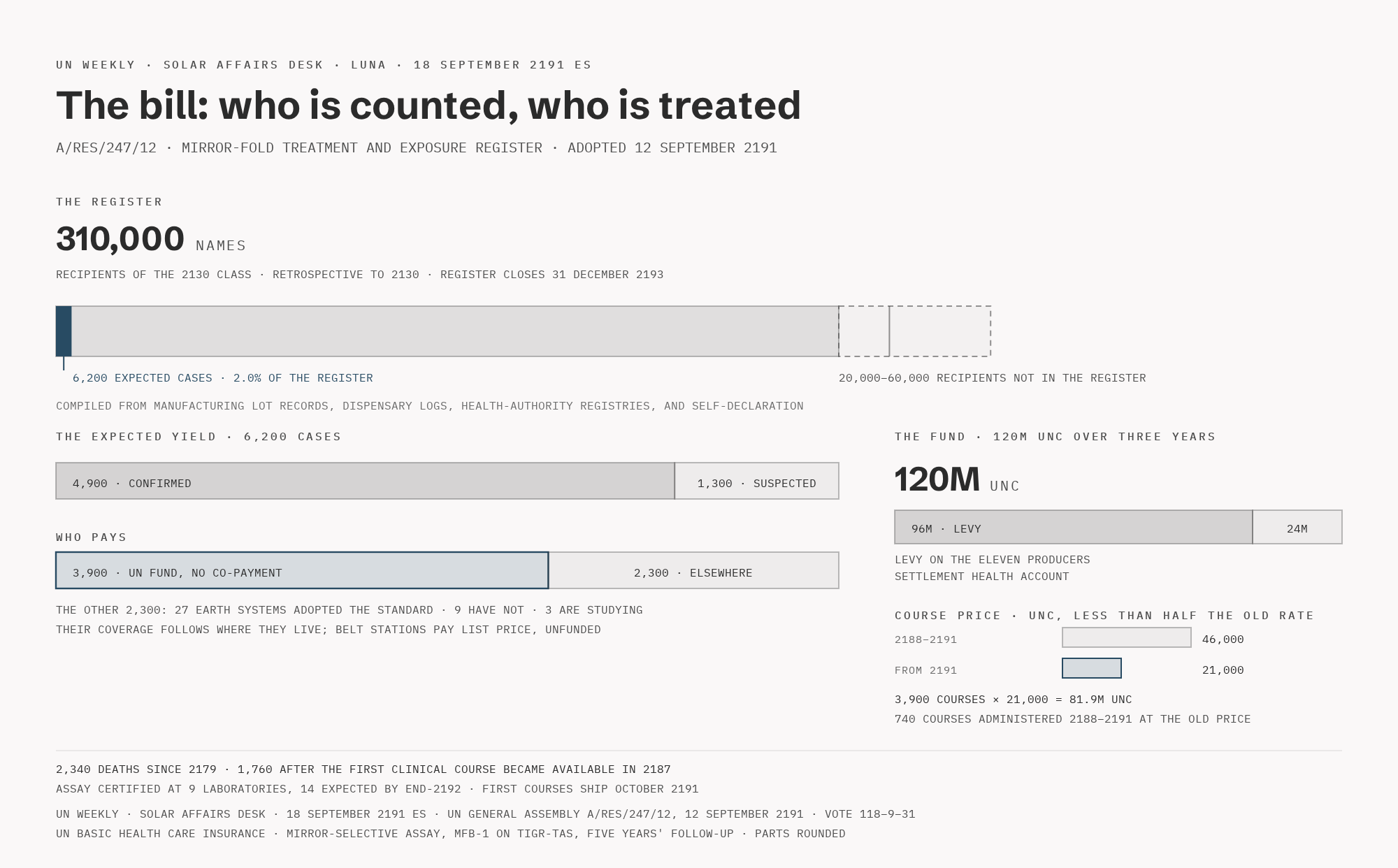
- The register. Every recipient of the 2130 class, retrospective to 2130, compiled from manufacturing lot records, dispensary logs, health-authority registries, and self-declaration. The register closes on 31 December 2193.
- The coverage. Diagnosis and treatment are added to UN Basic Health Care Insurance for UN citizens, with no co-payment.
- The standard. The mirror-selective assay at diagnosis and at twelve months; two administrations of MFB-1 four weeks apart on the TIGR-Tas chassis; five years of follow-up. The Assembly’s standard is now the standard of care in every UN jurisdiction.
- The levy. The eleven producers of the 2130 class pay 96 million UNC over three years, collected through the settlement health authorities.
- The purchase. The Secretariat buys 3,900 courses at 21,000 UNC each, the number of confirmed and suspected cases among UN citizens.
The invoice
The fund is 120 million UNC over three years: 96 million from the levy and 24 million from the UN’s settlement health account. The course price is 21,000 UNC, less than half the 46,000 the Dome 4 program charged between 2188 and 2191, when 740 courses were administered, most of them at Dome 4 and Boreas Station. The people who received those courses were the people who could reach a site and pay for one.
For UN citizens in the register, the fund pays. For the other 2,300 confirmed and suspected cases, coverage follows the plan where they live. On Earth, that means the national health systems: twenty-seven have adopted the Assembly’s standard, nine have not, and three are studying it.
The register
The 2130 patent was released under free license. There was no licensor to keep a register, and none was established. The Haddad paper reconstructed 310,000 recipients from lot records, 14 dispensaries, and two health authorities that happened to keep their own. The Assembly’s register is built on that floor.
It will hold 310,000 names. It will confirm 4,900 infections and 1,300 suspected cases. It will not hold the recipients whose producers kept no logs, whose dispensaries closed, or who were treated on a station that kept no records. The resolution’s own impact statement puts the uncounted at 20,000 to 60,000.
“We cannot treat people we cannot find,” said Dr. Halima Osei, director of the UN Office of Colonial Health.
The settlement
The 2155 suit alleged that Dome 4’s chiral nanobot cryosleep architecture reused Nova’s delivery technology. The cross-license covers the TIGR-Tas chassis and the MFB-1 binder, and the suit is withdrawn. No cash changed hands; the licenses cross.
Dr. Amelia Murphy, Nova’s founder, is 116. “We did not settle because the science was wrong,” she said. “We settled because the bill was larger than the suit.”
Dr. A. Vos, of Dome 4’s biomedical division and a co-author of the 2179 paper: “The license was free because we thought distribution was the problem. Distribution was not the problem. Counting was.”
The dead
The resolution’s preamble records 2,340 deaths since 2179. Of those, 1,760 came after the first clinical course was available at Dome 4 in 2187. The sponsors put the number in the preamble. The producers asked them to take it out.
Yusra Demir, the Titan greenhouse worker who told Boreas Broadcasting Network in 2179 that “there is a number that describes whether I am in it, and the number exists somewhere, and it is not available to me,” was diagnosed in March. She was critical in June. She was treated in July and discharged in August, at 76.
“I have a number now,” she said. “It came twelve years late. Two people in my block did not get one.”
The objection
A joint statement from the eleven producers called the levy a tax on a lawful product. “The 2130 license was released,” it said. “There was no licensor to keep a register. The Assembly is taxing the absence of a duty it never imposed.”
The Sovereign Miners’ Coalition said the register is a list of the stations that kept books. “The belt kept none,” a Tianshui delegate said. “Our people are not in it.” The resolution lets independent stations buy courses at the list price. It does not fund them. The Coalition has asked for a supplemental levy; the Secretariat said it would review the request.
What is still open
Nine laboratories are certified for the assay; the Secretariat expects 14 by the end of 2192. The fund covers 3,900 courses. The register may confirm more. The uncounted recipients have no route into the fund unless they can document exposure, and the documentation is the thing that was never kept.
The first courses ship in October. The register closes on 31 December 2193. By then the Assembly will know how many people are in it. It will not know how many are not.