Register consolidating minor UN bodies. Principal UN institutions retain individual entries (see Principal Institutions). UN Weekly is filed with the media outlets.
UNSF Criminal Investigations
Investigative arm of the United Nations Security Force. Opened a case file on the ELTS II android incident in February 2150, confirming through public-record request that the detained unit’s travel documents identified a real deceased Ceres miner. The investigation’s central question as of publication: where the unit came from, how long it had been in transit or hiding, and who helped it obtain the documentation. Prosecuted UNSF v. Patel (LIC-2152-0317); the docket was closed in 2157 without an opinion. — UN Weekly (2150), Petrescu petition (2190)
UN Office of Legal Affairs
Legal arm of the United Nations; issues formal legal notices and demands on the UN’s behalf. By 2132, served Argus Extraction Defense with a formal Article 4 violation notice following the Kuiper Belt site boarding, asserting corporate liability for at minimum thirty-three undeclared embodied general-cognition units across three sites (Hygiea, Pluto, Kuiper Belt). Issued an internal memorandum assessing jurisdiction gaps in the Charter regarding artificial objects in open space. In 2159, reviewing the Sovereign Miners’ Coalition’s Tianshui Compact demands, offered Hygiea administrative-gallery space for the Coalition’s secretariat, and confirmed a new belt-wide labor-rights oversight body is in formation. — Notice and Demand (2132), Legal Memo (2132), CNN (2159)
UN Office of Colonial Health
Health-policy office of the United Nations. In June 2155 it confirmed that over 200,000 people across the settled system carried MHA-1, the radioprotective treatment known as black blood. In September 2191 the General Assembly’s mirror-fold resolution added diagnosis and treatment of mirror-fold encephalopathy to UN Basic Health Care Insurance for UN citizens; the Office’s director, Dr. Halima Osei, said: “We cannot treat people we cannot find.” The 2195 Citizen’s Guide records that the Office sets the scheme’s benefits and standard of care and administers the mirror-fold register, which closed on 31 December 2193 with 310,000 names; Mars is outside the scheme, and the Authority’s health service decides coverage there. — The Peer Review (2155), UN Weekly (2191), Citizen’s Guide (2195)
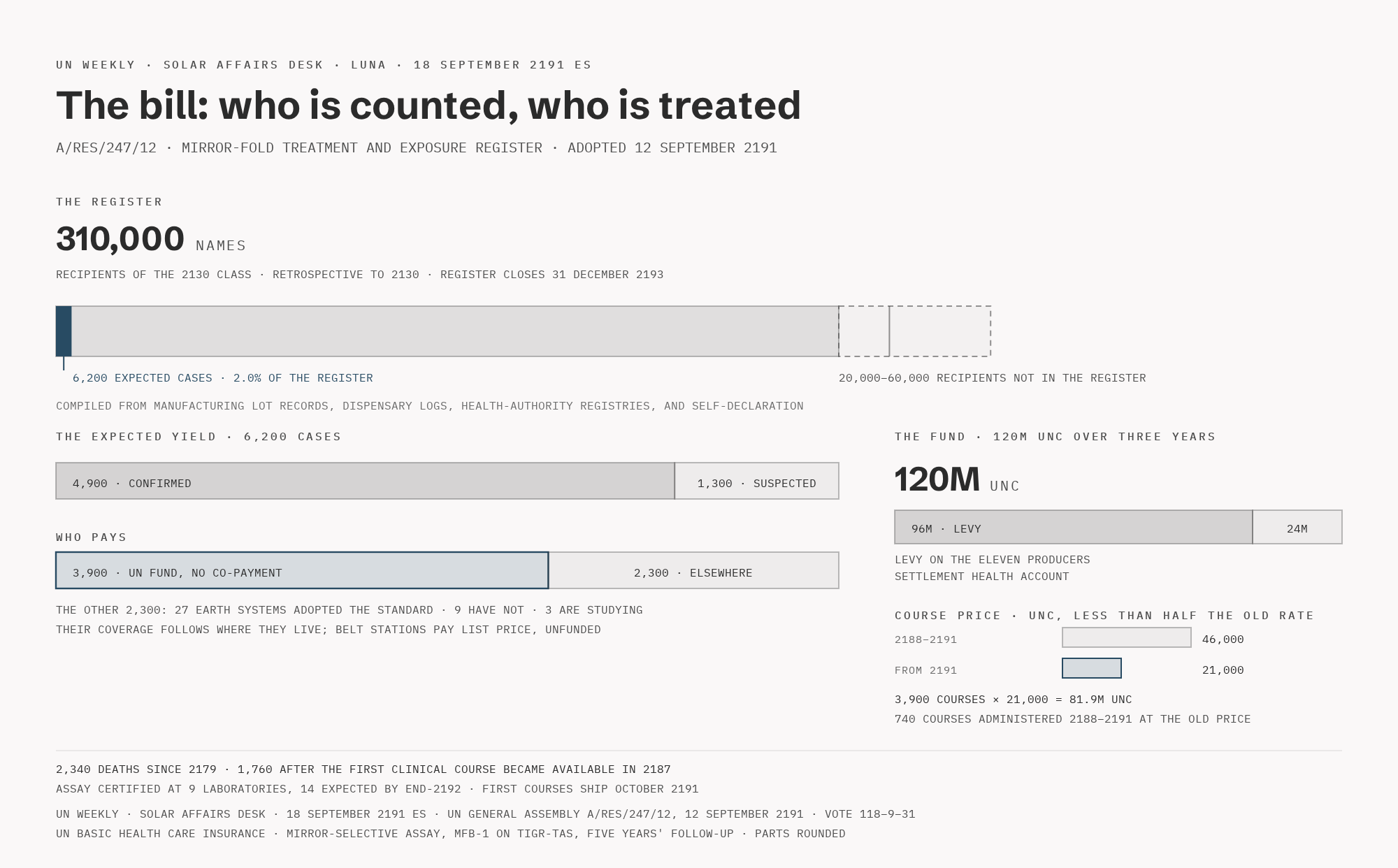
Figure from UN Weekly: The Bill — Assembly Adds Mirror-Fold Treatment to UN Insurance and Opens the Register (2191).
UN Permit Office
Handles extraction and exploration permits, with offices at Luna and Ceres. Established under the 2102 Permit Bill; applications are in person only, with no remote process. The 2195 Citizen’s Guide records the arrangement unchanged. — UN Weekly (2102), Citizen’s Guide (2195)
UN Orbital Remediation Administration
Chartered June 2157 under the UN Office for Colonial Development; mandate spans LEO through geosynchronous. Operates the first system-wide active debris removal fleet: twelve dedicated remediation tugs (first four under construction at Kosmograd’s shipyard, mid-2157) targeting large debris for controlled deorbit, plus a ground-based laser ablation system at three equatorial stations for nudging smaller objects into decay orbits. Initial appropriation: 4.1 billion UNC from Antimatter Bond surplus profits. Five-year target: forty percent reduction in tracked LEO debris mass. First director: Nancy Choi. — UN Weekly (2157)
UN Colonial Census Bureau
UN body responsible for settlement population tracking, orbital survey, and demographic reporting. Published the Mars report (2130): eight permanent settlements, ~121,000 registered residents, ~1,367 independent industrial outposts. First system-wide compilation (2155): ~1.22 million sustained human presence beyond Earth across Luna, Mars, the Belt, Jovian and Saturnian settlements, Pluto, and Venus. Second system-wide compilation (2165): ~2,508,000 sustained presence, up from ~1.22 million — growth at ~7.5 percent per annum, roughly 80 percent of it the Martian Great Settlement (~1.03 million net arrivals; thirteen settlements) — with scenario bounds of 50–100 million by 2200. Third system-wide compilation, The Bounds, Revised (November 2195): ~6,150,000 sustained presence, up from 2,508,000 — growth at 3.0 percent per annum, Mars 73 percent of the total and 87 percent of growth since 2165 — withdrawing the 32 million extrapolation and the 50–100 million bounds and replacing them with bounds of 7.0–8.2 million by 2200. Mars is counted as a separate reporting jurisdiction for the first time: the Martian Provisional Authority’s March 2195 census reports 4,820,000 residents against the Bureau’s 4,500,000 estimate. The 2195 Citizen’s Guide records the projections as revised after the 2183 Martian self-determination decision. — Mars Report (2130), The Settled Sphere (2155), The Settled Sphere (2165), The Bounds, Revised (2195), Citizen’s Guide (2195)
Civil Fleet Registry
Fleet registry of the UN, under the UN Office for Colonial Development. Classes Citadel-class carriers as mobile stations; issues and renews civilian armament certificates under the Civilian Armament Code (Registry Circular 2164-1), which grades civilian hulls in three armor classes and sets point-defense minimums by tonnage and route. In October 2168, following the Demeter raid, opened an amendment review of Circular 2164-1 amid insurer contestation of claims on hulls whose certificates and routes did not match. — UN Weekly (2165), Martian Radio (2168)
UN Patent Office
Patent registry of the United Nations, seated at Luna. Granted Pietro Galli’s “Superconducting magnetic decoupling collar for rotating habitation modules” — Patent No. UNPO-L/2166/0317 (filed 22 March 2164, granted 14 June 2166) — the first public filing covering an element of the Ark’s hull configuration; two further Galli filings published or pending as of 2168 (modular hard-point interface; agricultural-shell drainage under sustained axial thrust). — Patent (2166), Iron Orbit (2168)
Principal Institutions (individual entries retained)
- UN Office for Colonial Development — settlement infrastructure; successor to UNOLA
- UN Office for Lunar Affairs (UNOLA) — lunar administration dissolved by Article IV of the 2101 Charter; predecessor to the Office for Colonial Development and the Relay Directorate
- UN Relay Directorate — operator of the interplanetary relay network (established 2101)
- Office of Cognitive Assessment — emergence-confirmation authority under the 2148 Protocol and 2151 Charter
- UN Credit — the UNC currency, He-3-backed under Article III of the 2101 Charter
- UN Treasury — regulator of the monetary order; licenses banks at each major node, planned and launched the Antimatter Bond
- Jovian He-3 Trilateral Directorate — trilateral UN–Soviet–Chinese body administering the Jovian He-3 platform programme (established 2164)
- Xenobiology Archive — open-access database of non-terrestrial organisms (launched 2144)
- United Nations Security Force — the UN’s military arm in space
- UN Strategic Fleet Command — naval service under Security Council authority (established 2165)