UN Relay Directorate — the UN body that operates the relay layer of the settled system’s communications network, created in 2101 when the cislunar network section of the dissolved UN Office for Lunar Affairs was reconstituted under direct UN authority by Article IV of the Charter of 2101. It runs a chain of laser trunk stations, with ground and orbital terminals at each settled body and two relay stations on Earth’s orbit sixty degrees ahead of and behind Earth to see around the Sun during conjunction. The network is store-and-forward: every message, page, payment, and file travels as a sealed bundle held at each node until its next transmission window, and the Directorate sets six priority classes — distress and safety, governance (including CAI/Oracle queries and recommendations), navigation and fleet traffic, clearing and administration, UN publication, and everything else — that decide what moves first in a congested window. Bundle contents are sealed to the Directorate, which reads addresses and keeps routing records; off Earth the relay is funded by the UN and free at the point of use, as former UNOLA relay engineer Mirela Constantin described in How the UN Relay Works Across the Solar System (2102).
The 2195 Citizen’s Guide records governance traffic as class 2 and private traffic as class 6, and notes that Mars’s Soviet-built body network passed to the Martian Provisional Authority while the relay itself remains UN-owned. The independent belt stations remain outside the Oracle’s reach by geography — one of the Sovereign Miners’ Coalition’s grievances since before the Compact.
The Authority’s October 2184 communications audit found the same arrangement from the Martian side: a Soviet-built body network maintained under a manufacturer’s contract, a UN-owned relay node, and governance traffic queued in class 2 against private traffic in class 6. “We did not build it, we do not maintain it, and we do not decide what it carries first,” the communications office’s summary read. The Consulate’s own bulletins travel in class 2.
Figure
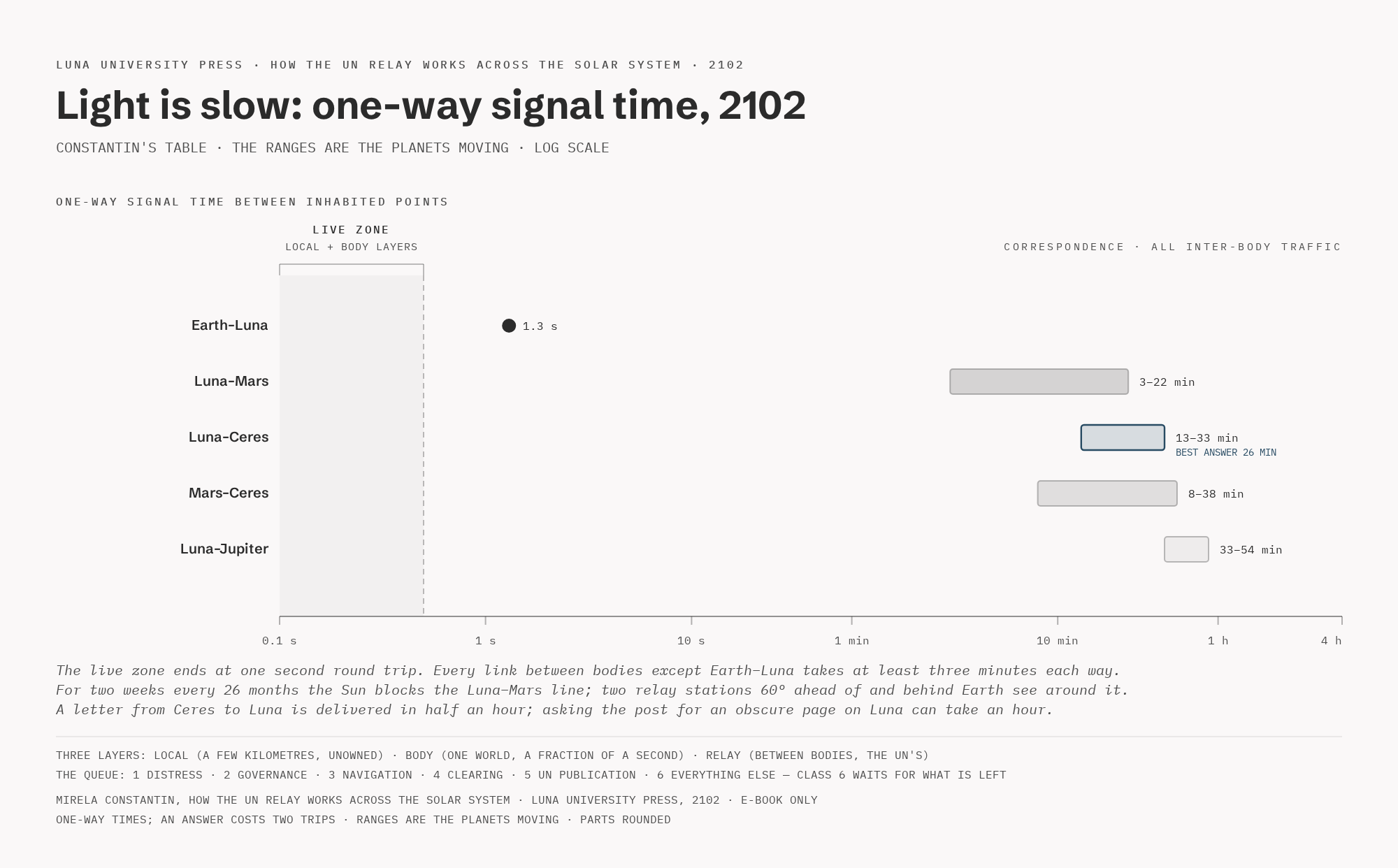
Figure from Constantin, How the UN Relay Works Across the Solar System (2102).
Sources
- United Nations Charter of 2101 — Article IV (excerpts) — dissolution of UNOLA and reconstitution under direct UN authority
- Constantin, How the UN Relay Works Across the Solar System (2102) — relay layers, mailbox principle, priority classes, privacy, Earth gateways
- UN Office for Colonial Development: Citizen’s Guide to Governance (2195) — class 2 governance and class 6 private traffic; Mars body network inherited by the Authority; relay still UN-owned
- Martian Consulate Bulletin: The MPA’s First Year (20 Dec 2184) — Martian communications audit; Soviet-built body network; UN-owned relay node; class 2/class 6 queue