Published 14 March 2195.
This is the 2195 edition of the Guide. The 2130 edition described a system with one government beyond Earth, a Council that had never used Article IV, and no law of synthetic personhood. All three have changed. The 2130 edition remains in the archive; where the two disagree, this one is current.
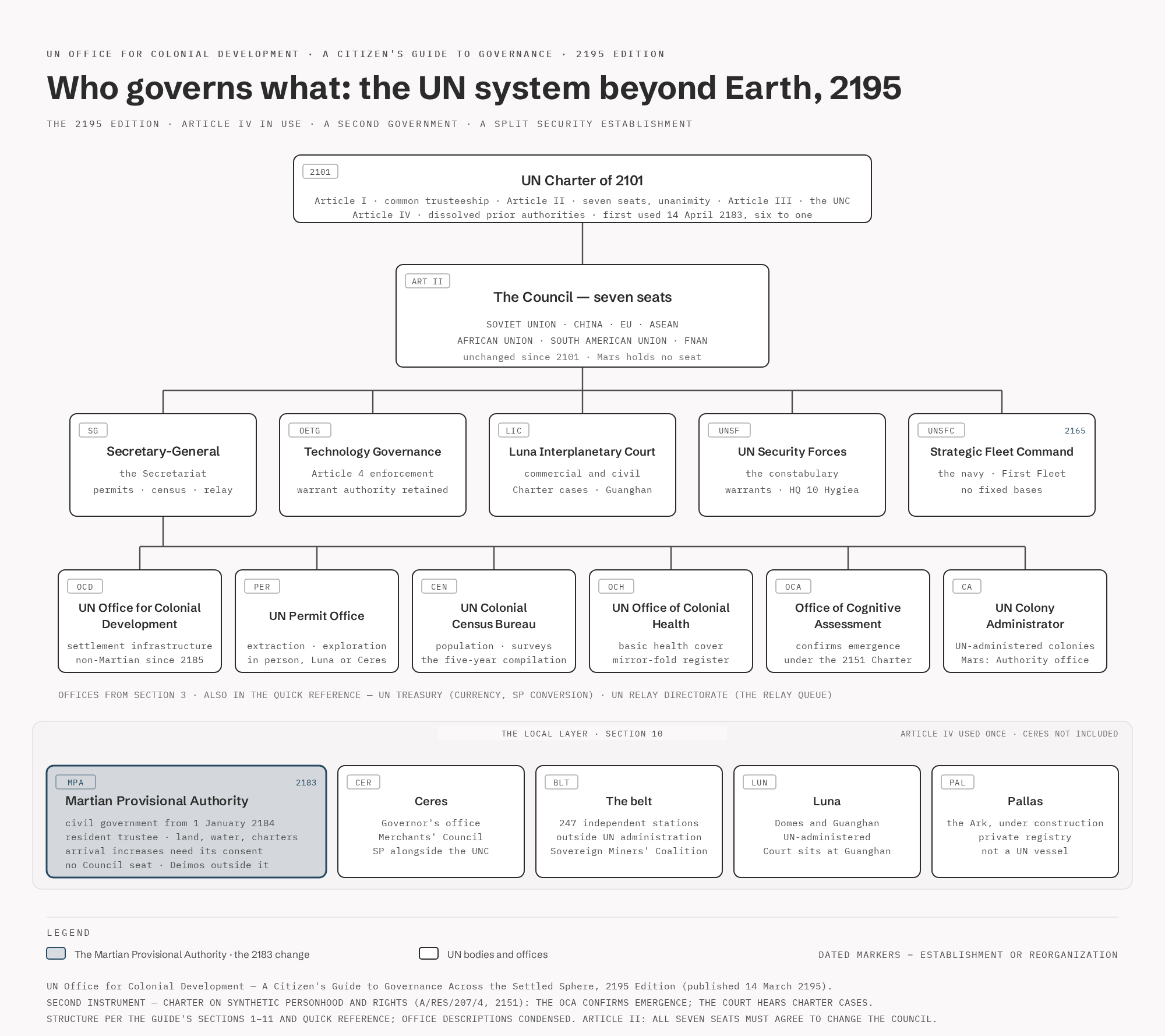
1. The Charter You Live Under
Everything still traces to the UN Charter of 2101. Article I holds every celestial body, and everything on or in it, in common trusteeship. Article II seats seven on the Council and requires all seven to agree before the Council changes its own composition. Article III establishes the UNC. Article IV dissolved the prior governing authorities and preserved existing governors and administrative organs “absent specific Council action.”
For eighty-two years, Article IV was a clause nobody used. On 14 April 2183 the Council used it. The Council Decision on Martian Self-Determination ended direct UN administration of Mars, recognized the Martian Provisional Authority as the planet’s civil government from 1 January 2184, and transferred land, water, and charter administration to it by 2185. The vote was six to one. The Soviet Union voted against.
Two features of the decision still shape what you can and cannot do on Mars. It named the Authority “resident trustee” of the planet, the first time the Charter’s trusteeship has been exercised by the people living on the body held in trust. And it left Article I’s common trusteeship in place: Mars governs itself, but it does not own itself, and it does not sit on the Council. Article II’s unanimity requirement kept a Martian seat off the table, because the Soviet Union would not have assented.
The second instrument is the Charter on Synthetic Personhood and Rights (A/RES/207/4), adopted in 2151 after the ELTS II incident. It defines a synthetic person, prohibits deliberate creation, confers rights on confirmed emergence, and requires a visible marker as the condition of those rights. It reserves the organic-substrate question. That reservation is still open.
2. The Council and the Secretariat
The Council still has seven seats: the Soviet Union, China, the European Union, ASEAN, the African Union, the South American Union, and the Federation of Northern American Nations. It still requires unanimity to change its composition. It has not changed.
The Secretary-General remains the UN’s chief administrative officer. The Secretariat is the body that turns Council decisions into the things you actually encounter: the permit window, the census, the relay queue. In 2183 the Secretary-General released the text of a CAI recommendation for the first time, on the Mars decision; the text ranked three paths and the Council took the highest-ranked one. That release is now the precedent for decisions above a set threshold.
3. Offices You’ll Actually Deal With
UN Office for Colonial Development. Settlement infrastructure and research facilities. Since 2185 its Martian land, water, and charter functions belong to the Authority. It still builds everywhere else.
UN Permit Office. Extraction and exploration permits. Still in person, at Luna or Ceres. There is no remote application.
UN Colonial Census Bureau. Population, orbital surveys, the periodic census. The 2165 census counted 1.33 million on Mars alone. The 2200 projections were revised after 2183; the current bounds are published separately.
Your Colony Administrator. For UN-administered settlements. Mars has the Authority instead; if you live there, your point of contact is the Authority’s settlement office.
UN Office of Colonial Health. The office that sets the benefits under UN Basic Health Care Insurance and administers the mirror-fold register. See Section 6.
Office of Cognitive Assessment (OCA). Confirms cognitive emergence under the 2151 Charter. If a platform in your employment is suspected of emergence, the OCA is the office that decides.
4. Law and the Courts
The Luna Interplanetary Court, at Guanghan, hears interplanetary commercial and civil disputes, and the Charter cases. The 2155 Nova Biosciences suit against Dome 4 over the chiral nanobot cryosleep architecture was settled in 2191 as part of the mirror-fold license. The second platform case under the 2151 Charter reached the Court in 2190 and is pending.
Mars now has its own courts. The Authority’s Court of First Instance at Pobeda hears Martian matters, including the second platform case’s custody question; the Luna Interplanetary Court retains the Charter question. The two have not settled which court decides what, and the second case is the test.
The Charter has no provision for a vessel built and registered outside any settlement. The Ark, under construction at Pallas and scheduled to depart within its published 2200 window, will be the first object to test that gap.
5. Money
The UNC is still the standard unit, backed by the pooled He-3 stockpiles held by the Soviet Union, China, and the UN. The Jovian He-3 programme, approved in 2165, has been producing since the first platform was placed in 2170; the pool is deeper than it was in 2133.
Ceres still uses the SP alongside the UNC. The Antimatter Bond, launched in 2142, is the hard reserve above the UNC; it is no longer a planning instrument.
6. Health and Insurance
UN Basic Health Care Insurance covers registered UN citizens. It pays for primary and emergency care, occupational injury, maternity care, and, since 2191, mirror-fold encephalopathy. The scheme is administered by the settlement health authorities; the UN Office of Colonial Health sets the benefits and the standard of care. Mars is not in the scheme. The Authority runs its own health service, and coverage there is a Martian question.
The 2191 resolution (A/RES/247/12) added MFE to the scheme and did four other things. It created the exposure register, retrospective to 2130, which closed on 31 December 2193 with 310,000 names. It set the standard of care: the mirror-selective assay, two administrations of MFB-1 four weeks apart on the TIGR-Tas chassis, and five years of follow-up. It levied 96 million UNC on the eleven producers of the 2130 class over three years. And it bought 3,900 courses at 21,000 UNC each for the confirmed and suspected cases among UN citizens.
What the scheme does not do is cover everyone. Coverage follows the health authority you are registered with. If you are a UN citizen and you are in the register, the course is covered with no co-payment. If you are an Earth national, your national health system decides; most have adopted the Assembly’s standard, and some have not. If you live on Mars, the Authority’s health service decides, and the UN scheme does not apply. If you live on an independent belt station, you are not in the scheme; the station can buy courses at the list price, and the Sovereign Miners’ Coalition has asked for a supplemental levy to fund its members. The Secretariat is reviewing the request.
The register is incomplete. The 2130 patent was free-licensed, and no licensor kept a recipient record. The register was rebuilt from lot records, 14 dispensaries, and two health authorities that kept their own. The resolution’s impact statement put the uncounted at 20,000 to 60,000. If you were treated with the 2130 class and your station kept no records, the settlement health authority can tell you whether you are in it, and what the scheme will cover.
7. Research, CAI, and the Rules Around Both
The five Luna Research Domes remain: Dome 1 (energy and engineering), Dome 2 (closed-loop agriculture), Dome 3 (cognitive systems and the Oracle), Dome 4 (biomedical and radiosynthesis), Dome 5 (propulsion and power).
The 2052 Charter on Embodied Cognitive Systems still governs the line between permitted and prohibited cognition. Article 4.1 prohibits general cognition in an embodied platform. Article 4.2 permits specialized-function systems under license. Article 4.4 permits non-embodied general intelligence, which is CAI, to supervise licensed specialized systems remotely. The 2151 Charter added the personhood path for confirmed emergence; the OCA is the office that confirms it.
The Oracle at Luna and the advisory core at Hygiea return identical wording. The Secretariat logs the agreement as validation. It has no explanation for it.
8. Communications and the Relay
The relay queue is still the only layer with one owner. Traffic is queued by class: governance traffic is class 2, private traffic is class 6. The UN decides what the outer settlements hear first, and in what order.
Mars’s body network is Soviet-built and was preserved by Article IV; the Authority inherited the network, and the relay remains UN-owned. The Oracle answers where a core is installed. The independent belt stations are outside its reach by geography, which is one of the grievances the Sovereign Miners’ Coalition has carried since before the Compact.
9. Security
The 2165 split still holds. The United Nations Security Forces are the constabulary: the High Provost Marshal, headquarters at 10 Hygiea, the Aegis corvettes, the Marines, peacekeeping, and warrants. The UN Strategic Fleet Command is the navy: the Chief of Naval Operations, the First Fleet, carriers, battleships, destroyers, frigates, and corvettes, with no fixed bases and command travelling with the fleet.
Strategic Fleet construction at the Deimos yards remains outside the Authority, under the 2078 arrangements with Moscow. The OETG retains warrant authority for Article 4 compliance reviews.
10. Local Governance
Mars. The Authority is the civil government, the resident trustee under Article I. It administers land, water, and charters, holds a binding veto over increases in licensed arrivals, and runs its own courts and its own health service. Deimos, the reactor programme, and all Strategic Fleet construction at the Deimos yards are outside its jurisdiction. It has no Council seat. The charters it administers are held for life, and on Mars lives have stopped ending, which is the inheritance problem the Authority has not solved.
Ceres. The Governor’s office and the Ceres Merchants’ Council remain the bodies residents deal with. The 2183 decision’s Article IV reasoning has not been extended to Ceres. The SP remains in use alongside the UNC.
The belt. The 247 independent stations are not UN-administered. The Sovereign Miners’ Coalition, founded by the Tianshui Compact in 2159, has its secretariat at Hygiea and bargains for registered and unregistered workers alike.
Luna. The Domes and Guanghan remain UN-administered; the Luna Interplanetary Court sits at Guanghan.
Pallas. The Ark is under construction at Pallas under private registry and is not a UN vessel.
11. Advocacy and Civil Society
The Article Four Coalition still pushes to keep Article 4.1’s prohibition intact. Dominium Hominis, dormant since the 2105 raid, resurfaced in 2137 with a pilgrimage claim at Pluto and has settled Persephone Reach and several Spacer’s sites. The Sovereign Miners’ Coalition is the belt’s largest organisation. Red First is the Martian movement that produced the 2182 Convention and, indirectly, the Authority.
Quick Reference: Who Do I Contact For—
| If you need to… | Contact |
|---|---|
| File an extraction or exploration permit | UN Permit Office (Luna or Ceres, in person) |
| Report settlement infrastructure needs | UN Office for Colonial Development |
| Resolve a commercial or civil dispute | Luna Interplanetary Court |
| Report a suspected Article 4 violation | UN Office for Emerging Technology Governance |
| Confirm a cognitive emergence | Office of Cognitive Assessment |
| Check your MFE register status | UN Office of Colonial Health; your settlement health authority |
| Martian health cover | Martian Provisional Authority health office |
| Ask about currency or SP conversion | UN Treasury |
| Ask about the relay queue | UN Relay Directorate |
| Raise a Martian matter | Martian Provisional Authority |
| Buy a course outside the scheme | UN Office of Colonial Health |
This guide is revised periodically. Where this edition and the 2130 edition disagree, this one is current.